The email lands in your inbox on Tuesday with no agenda. The subject line reads "Offsite, Q2?" and your CEO has scribbled one sentence: 80 people, somewhere warm, figure out the dates.
By Thursday three people on the exec team have opinions about the city, finance has asked what this costs, and no one has approved a budget.
You already know the checklist. Set a goal, survey the team, pick a venue, book the travel, run the event. Honestly, every decent guide to corporate offsite planning hands you the same one. What none of them say is who does each step, how many weeks it takes, and how many separate companies end up holding a contract with your signature on it.
The 9 contracts
A venue is not one purchase. On an 80-person program in a resort market, you’ll execute ~9 separate agreements:
- the hotel room block and meeting space
- A/V
- ground transport
- tours / activities
- off-property dinner(s)
- the photographer
- the keynote speaker
- swag
- event cancellation insurance
Most people only scrutinize the first of them.
The A/V company is usually the hotel's exclusive in-house provider, so unfortunately you're negotiating with a vendor you can't replace. Ground transport wants the pickup list signed 3 weeks out and bills by the vehicle, not per head. One late swing in RSVPs can cost you a whole coach bus.
To book the activity vendor and the photographer, you need a Certificate of Insurance from each naming your company as additional insured. Their brokers take a week (at best!) to issue one, after which procurement will nix the first version for using the wrong legal entity name.
So who chases all that? Probably you. If you’re the Chief of Staff, you're the one emailing a stranger's insurance broker in April.
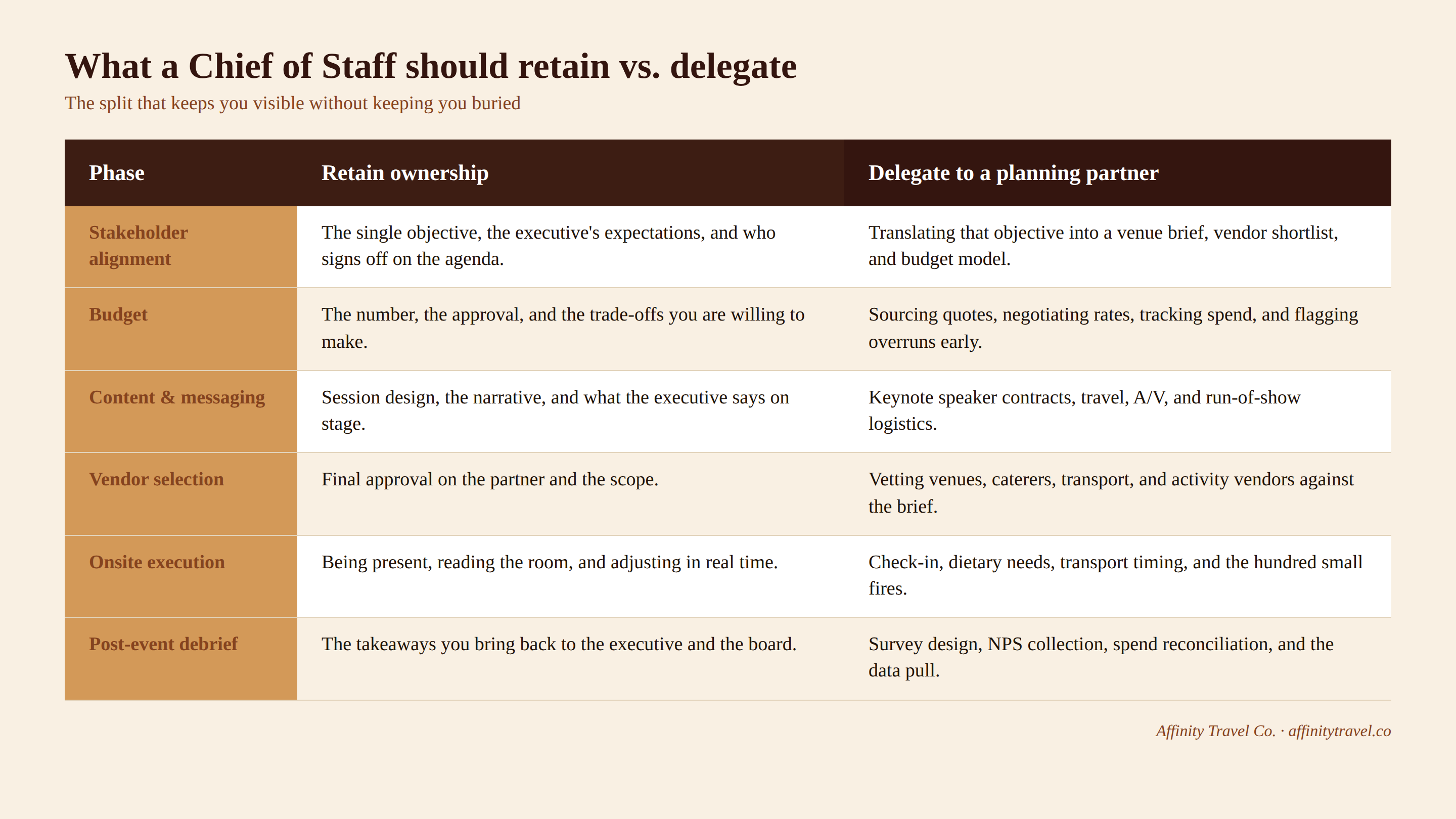
When we run a program this size, we handle 8 of those 9. That's the real difference between a planner and an AI app.
(For more on the cost of these agreements, read our breakdown of what a corporate offsite costs.)
Week by week, from the go-ahead to the signed room block
Sourcing a venue for a group that size runs 6 to 8 weeks at the best of times. Here’s how it goes:
- Week 1. You write the offsite objective in one sentence and send the staff survey.
- Week 2. The RFP goes to 6 or 8 properties, with the dates plus 2 alternates, expected room nights, meeting space needs by the hour, the F&B plan, the A/V requests, and the concessions you're asking for.
- Week 3. Responses land, though some venues ghost you. Hotels answer the RFPs they think they can win.
- Week 4. The site inspection. A sales manager will walk you through the ballroom with the house lights up. Ask to stand in it at 2pm, when your workshop is scheduled and the west wall is doing its best impression of a heat lamp.
- Weeks 5 and 6. Redlines. Expect 2 or 3 round trips on attrition, the cutoff date, force majeure, and the resell clause. This is where timelines slip, because the hotel's contract manager is working dozens of other projects.
- Week 7. Deposit. Finance needs a W-9 and 10 business days to cut the check, which they didn’t tell you in advance.
Count backwards from your dates, then add 2 weeks of buffer.
Can it be done faster? Yes, with help. A 60-person sales kickoff in Miami came to us within T-8 weeks and earned an event NPS of 77.
Here’s the survey you send in week 1
Survey the team before you set the goal. Doing it later turns the survey into a ratification exercise.
The answers are what you use with stakeholders who can veto your plan. An executive will argue with your opinion. He will not argue with 60 responses.
Send it from your own email to everyone attending, with a 3-day window. 5 questions, in the words you'd type:
- What is the one thing you want to leave this offsite knowing?
- What’s the most important decision you want this event to settle?
- Which team do you work with most? Which do you understand least?
- What would make you regret the travel?
- Anything we should know about your travel, your diet, or other accomodations?
If fewer than half the team answers inside 3 days, have your principal forward the same link indicating it’s mandatory and urgent. Response rates jump, which tells you something about the company worth knowing.
How the budget changes
The quote you approved and the invoice you pay are different documents. The gap between them was likely written into a contract months earlier.
The F&B minimum is a floor on catering spend you owe whether or not your group eats it. The attrition clause applies the same idea to room nights. Hotels typically require you to fill 80 to 90% of the contracted room block, and falling under that threshold means paying for rooms that sat empty.
Groups360 advises asking for 20% attrition instead of 10% when a group is unpredictable. Ask as well for free name changes up to 24 hours before arrival. That's the clause that saves you when 3 people resign after getting their bonuses in March.
Sadly, the market isn't helping. Hotel average daily rates rose 2.2% year over year in the first quarter of 2026. In the Amex GBT 2026 forecast, 71% of meeting professionals expect cost per attendee to rise, with cost now the top planning challenge at 38%, from 601 professionals across 8 countries. Our corporate offsite budget guide shows what different per-head numbers buy once everything is priced in.
On call or on fire?
The agenda is just a piece of paper until somebody stands outside at 6:40am and counts buses.
The run-of-show is what matters on the day, not the agenda. An agenda says "10:00, breakout sessions". A run-of-show says which room, who has the key, where the 4 flip charts are stored, which technician is on call, and who walks your CEO to the stage. Writing it takes a full day, which no one budgets for.
And of course plans change anyway. Your CEO decides to add a photo montage to the closing session at 10pm, long after the A/V tech went home at 6, so the overtime you are about to authorize gets billed per technician per hour at a rate that never appeared in the budget.
Who fixes a bus that hasn't arrived? The person standing in the lobby with the driver's cell number. No dashboard or email thread can substitute for her, which is why we offer on-site staffing for programs we plan.
The debrief, and why it matters
The closing dinner isn't the end of the program, whatever the run-of-show says.
Measure 3 times: send a modified version of the pre-survey and NPS right after the event, again at 30 to 45 days, and check progress against the strategic metric / goal at 90 days. The first tells you whether the room worked. The second shows whether anything stuck. By 90 days you're answering whether it was worth it.
Our Austin offsite for 40 people earned an event NPS of 87, with over 80% of respondents agreeing they could do their jobs better afterward.
Those are the two lines you carry into the funding conversation. An offsite with a number attached is easy to fund again, while one everybody felt good about is the first line a CFO cuts. If that conversation is the hard part, our guide to building the business case for a company offsite will help you out.
What to cut when the dates are already too close
Sometimes you absolutely have to schedule for 5 weeks out and nothing is booked. What comes off first?
The off-property dinner. It's a second venue contract and transportation schedule you don't have time to handle. Then take the RFP list down to 3 properties, and run the site inspection as a video walkthrough with the sales manager narrating.
Keep the meeting space, the A/V, and one activity. That's the smallest vendor set that still produces a viable offsite program rather than a hotel stay.
What can't be compressed is the catering guarantee or the block cutoff. Those belong to the hotel rather than to you, which is the whole reason a short runway argues for handing over more of the work instead of staying up late to source, negotiate, contract, and write a run-of-show alongside your real job.
Be in the room where it happens
The fear underneath all of this is that handing the work over means handing over the credit and the outcome.
It’s actually the other way. Hold every thread and your executive sees you as a stressed coordinator. Hand off the operations while keeping the decisions, and the same executive sees a reliable strategist who designed and executed the program.
You're in the room either way. The question is whether you're glued to your phone all day, or making meaningful contributions.
Affinity Travel Co. is a single partner that plans and executes corporate offsites and executive retreats for groups of 10 to 500+, booking and managing every vendor from venue to private dining to ground transport, with staff on site for the program. We've run 30+ programs across 28 countries for 900+ guests.
If you’re running a larger event, read our guide to planning an offsite for 100 people. And if you just want help, send us the dates, the headcount, and the outcome your CEO wants - all you have to do is request a proposal (it's free).
Frequently asked questions
What should a chief of staff do in the first week after an offsite lands on them?
How far ahead does an 80-person offsite need to start?
How many vendor contracts does one corporate offsite involve?
What belongs in a hotel RFP so the proposals come back comparable?
What should a chief of staff never hand to a planner?
Is it too late to bring in a planner 5 weeks out?