Corporate offsite cost: a transparent breakdown by budget tier
Companies budget for offsites the way they budget for software: they anchor on a number someone said in a meeting, discover it's wrong three weeks before the event, and scramble. This post gives you the actual numbers, organized by tier, so you can plan from the start with a realistic figure in hand.
These numbers come from programs ATC has planned and delivered, not from vendor brochures.
What drives corporate offsite cost
Before the tier breakdown, here are the five levers that move the number most:
Venue and lodging is usually 40 to 50 percent of total spend. Single-occupancy rooms are the standard expectation for professional offsites and they add up fast. A mid-range hotel at $200 per night for 100 people is $20,000 per night before you've bought a meal or rented a meeting room.
Food and beverage typically runs 20 to 30 percent. Group F&B has high per-person minimums and service charges that catch people off guard. A dinner at a restaurant with 130 people, including beverage minimums, venue fee, tax, and gratuity, often runs $150 to $250 per person.
A/V and event space is where planners routinely underestimate. Hotel A/V packages for two days of presentations, breakout rooms, and basic lighting can run $10,000 to $40,000 depending on group size and production quality.
Ground transportation adds up for groups traveling from multiple cities or using remote venues. Shuttles from a regional airport to a camp-style property an hour outside Austin are not optional, and they're not cheap.
Planner fees are a line item many first-time offsite planners try to eliminate. That's the wrong call. A 40-person offsite is a real workstream: venue sourcing, vendor coordination, on-site support, agenda management. ATC's Austin client estimated that before working with us, the CEO spent 80 hours planning each retreat himself. With ATC, that dropped to 15 hours. The math on that time is straightforward for any growth-stage company.
The three-tier budget breakdown
These tiers are based on 100 attendees, a 2- to 3-day domestic program, and single-occupancy lodging. Per-person costs at different headcounts follow below.
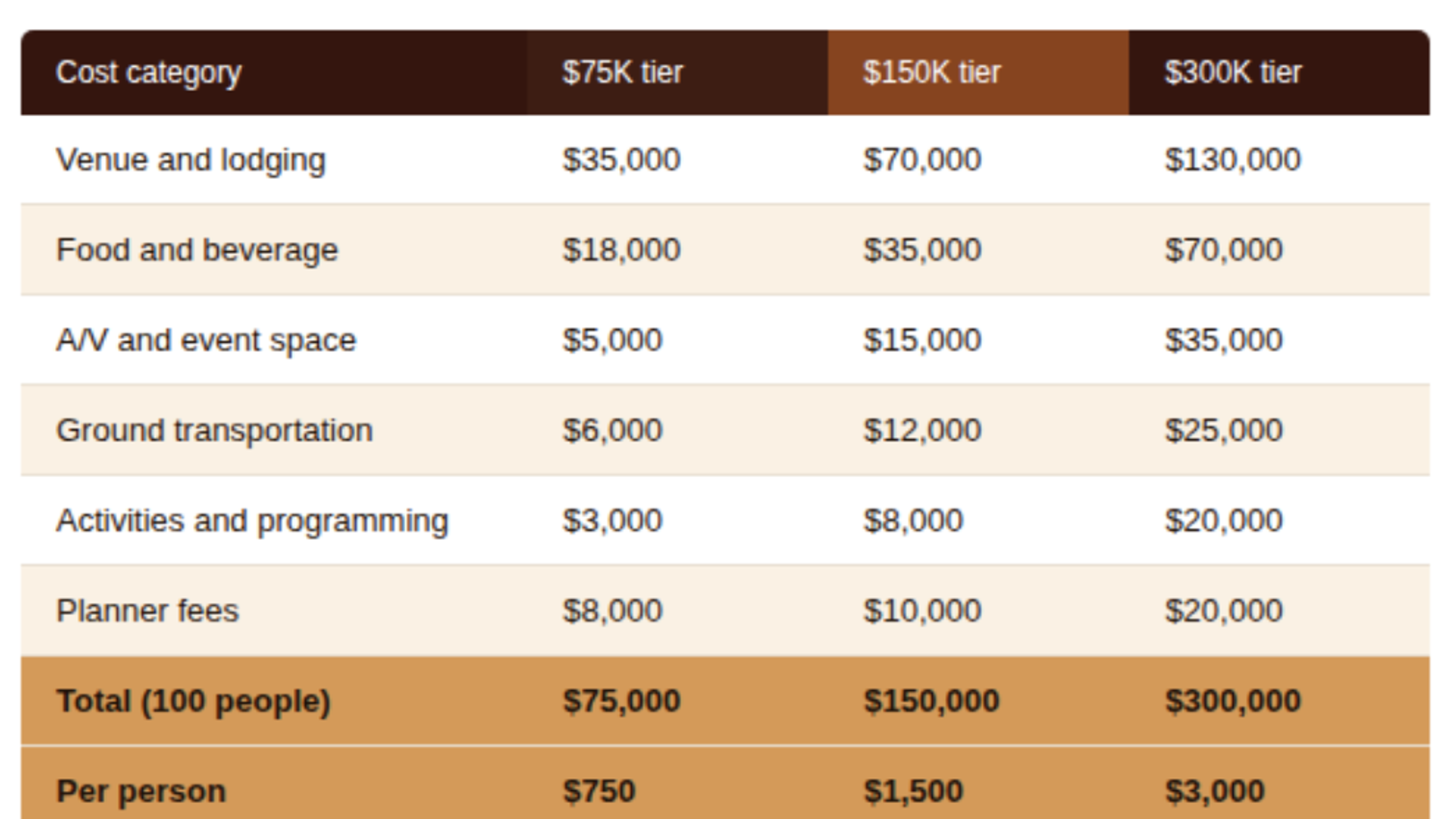
Flights are excluded from all three tiers. Budget an additional $300 to $700 per person for domestic flights, or $900 to $1,800 for international.
What each tier actually gets you
$75K tier ($750/person): A regional U.S. destination, shared rooms or a hostel-style property, boxed lunches, catered dinners, and minimal A/V. This is the floor for a professional event. It works for small, scrappy teams with a strong culture. It does not work if your attendees are used to anything above basic accommodations.
$150K tier ($1,500/person): A well-located hotel or retreat property with single-occupancy rooms, two or three real group meals per day, a production-quality meeting room, basic activities, and a full-service planner. This is the most common tier for growth-stage companies at 50 to 150 people.
$300K tier ($3,000/person): A premium property, possibly international, with private dining, a full activity program, custom gifting, a dedicated on-site coordinator, and meaningful production value. This is the tier for companies where the offsite is a signature event.
Cost per person at different headcount
Smaller events are not automatically cheaper. Variable costs like lodging and F&B scale down with headcount, but fixed costs don't. Venue rental, A/V, planner fees, on-site coordination, and facilitation all get divided among whoever shows up. The fewer people splitting those costs, the higher the per-person number.
A 10-person executive retreat at a quality property can easily run $4,000 to $6,000 per head. Scale to 100 people and that same per-person figure drops dramatically, even with a larger total budget. Bigger groups typically have more efficient budgets and when you’re blocking 100 rooms vs 10 rooms at a hotel, you can typically negotiate better rates too.
What real programs actually cost: two ATC examples
40-person Austin startup retreat: $1,416 per person
A Series A tech startup that had grown from 18 to 40 employees in six months came to ATC for their first large-group offsite. Their goals: build connection across a fast-growing team, align everyone on sales strategy, and execute a client dinner with 12 current customers and prospects.
The budget was $1,400 per person excluding flights, covering the venue, all meals, transportation, and activities. The offsite came in at $1,416 per person after planning fees and swag. Flights averaged $420 per person from various home cities to Austin.
The venue was a private camp-style retreat in Texas Hill Country with cabin rooms, a pool, pickleball courts, and indoor session space. Meals included catered lunches and dinners on-site and a farewell dinner from Salt Lick BBQ. An ATC on-site coordinator managed all food logistics since the property was an hour outside Austin, too far for group restaurant runs.
The event earned an NPS of 87. Over 80 percent of attendees said they could do their jobs better after attending.
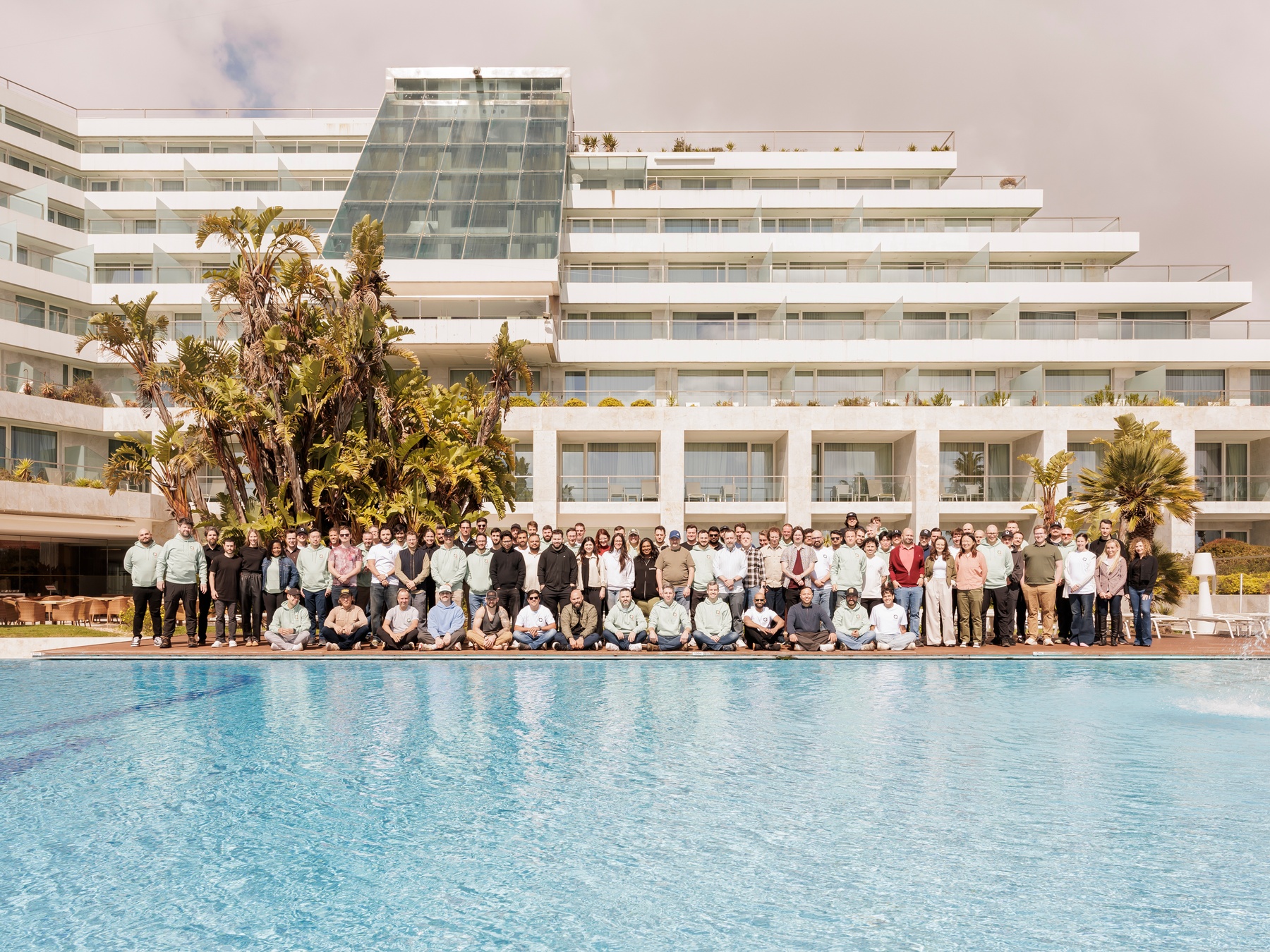
130-person Lisbon offsite: $1,566 per person
A Series B blockchain infrastructure company with 130 employees across 20 countries budgeted $1,800 per person (excluding flights) for their annual global offsite. The budget needed to cover single-occupancy hotel rooms, all meals, local transportation, event space and A/V, activities, and planning fees.
The offsite came in at $1,566 per person. A mid-event complication: Hurricane Melissa destroyed the original venue in Jamaica two months before the event, requiring a full destination rebuild to Cascais, Portugal. ATC rebuilt the entire program in under three months.
The Lisbon program included a hotel in Cascais that provided breakfast and lunch daily, two privatized Michelin-starred dinners for the group, flexible free time with local recommendations rather than forced group activities, and a structure where individual employees used company-issued Ramp cards with daily spending limits for incidentals. No post-event finance reconciliation nightmare.
Ninety percent of the employee base attended in person. The event earned an NPS of 82.
Hidden costs that blow budgets
These are the line items that don't show up in the initial vendor quote and regularly surprise first-time planners.
Resort and hotel fees. Many properties charge a daily resort fee per room ($30 to $75) on top of the room rate. On 100 rooms for three nights, that's $9,000 to $22,500 in fees that look like a rounding error until you see the master account.
F&B minimums. Conference hotels often set minimum spend thresholds for catered meals and events. If your group comes in under the minimum, you pay the minimum anyway.
A/V overages. Hotel A/V is priced by the hour and by the item. A technician for a full day, an extra screen, a clicker. These add up. Get an itemized quote before signing.
Gratuity and service charges. Most hotel and catering contracts add 22 to 26 percent in service charges and gratuity on top of quoted F&B prices. A $10,000 dinner becomes $12,200 to $12,600 before tax.
Transportation for remote venues. Camp and retreat properties outside major cities require charter buses or shuttle services. A single day of shuttles for 100 people between an Austin area airport and a Hill Country property can run $3,000 to $5,000.
Frequently asked questions
What is the average cost of a corporate offsite per person?
What is the biggest cost driver in a corporate offsite budget?
Should planner fees be in the offsite budget?
How do I budget for a corporate offsite I haven't planned before?
What does a $150,000 corporate offsite actually look like?