How to justify a company offsite to your CFO (and actually win the budget)
Your CFO is not wrong to push back on offsite spend. A multi-day retreat for 80 people can run $150,000 or more. That is a real line item. The question is whether the return justifies the investment — and the honest answer is yes, if you plan it right and measure it honestly.
The mistake most leaders make is not the offsite itself. It is pitching the offsite as a culture spend when the CFO is thinking in EBITDA terms. Those two conversations will never converge. Here is how to start the right one.
The numbers your CFO will actually listen to
Start here. Three data points do most of the work:
SHRM puts the cost of replacing an employee at 50 to 200 percent of annual salary. For a $100,000 role, that is $50,000 to $200,000 in recruiting fees, onboarding, lost productivity, and manager time. A well-designed offsite that retains even one person who was on the fence about leaving pays for itself before you account for any other benefit.
Gallup's 2024 State of the Global Workplace report found that top-quartile business units achieve 23 percent higher profitability than bottom-quartile units. The driver is employee engagement. Offsites, when designed around shared achievement rather than forced fun, are one of the most reliable ways to move engagement metrics at scale.
Emburse's State of Corporate Offsites survey, which polled 2,000 U.S. employees in late 2024, found that 59 percent of companies have increased their offsite budgets since 2019. Companies are not increasing budgets because it feels good. They are doing it because the events work.
These are not soft arguments. They are the inputs your CFO uses to evaluate every other capital allocation decision. Use them.
Why the standard pitch fails
Most budget requests for offsites sound like this: "It will be great for morale. The team really needs this. It will help us align."
That is not a business case. That is a hope.
CFOs think in terms of risk-adjusted return. They want to know: what does this cost, what does success look like, and how will we know if it worked? When the answer to all three is vague, the request gets cut. Every time.
The fix is to reframe. Stop pitching the offsite as an expense and start presenting it as a capital investment with a measurable thesis.
The CFO-ready framework: translate your goals into financial language
Every common offsite objective has a financial equivalent. Here is how to make the translation.
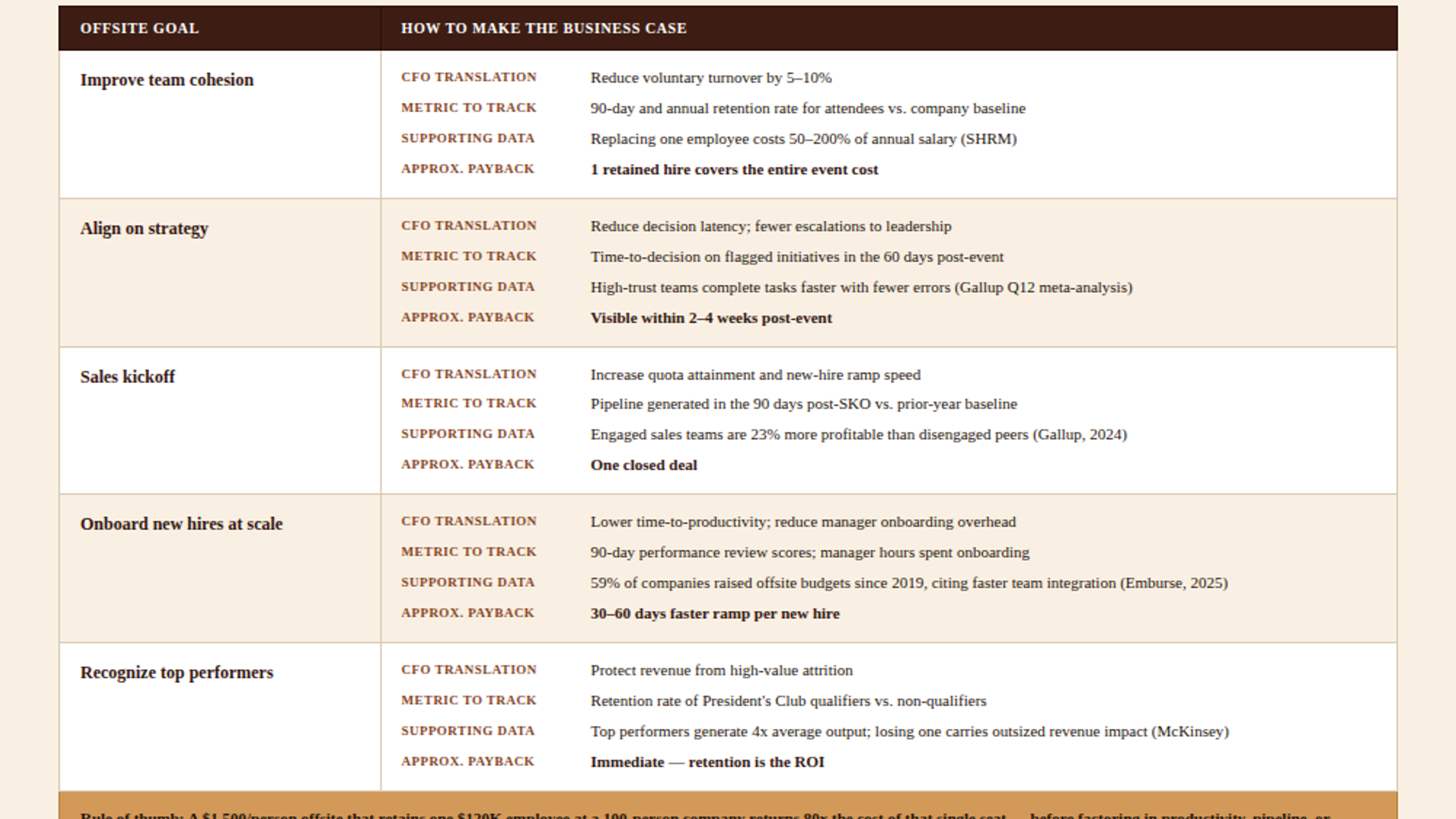
Print this. Bring it to your budget conversation. Pick the row that matches your primary objective and build the slide deck around it. One slide. One thesis. One set of metrics you commit to tracking.
What "measurable ROI" actually looks like in practice
Measurement is where most companies quit too early. They run the offsite, send a post-event survey, and call it done. That is not ROI measurement. That is sentiment capture.
Real ROI measurement for a company retreat looks like this:
Define your success metric before the event. If the goal is retention, track 90-day voluntary turnover for attendees versus your baseline. If the goal is pipeline, measure deals opened in the 60 days after a sales kickoff versus the same period the prior year. If the goal is strategic alignment, track how many decisions from the offsite were implemented and at what speed.
Survey your team, but ask business questions. "Did you feel more connected?" tells you nothing a CFO can use. "Do you have a clearer understanding of our sales strategy?" and "Do you feel better equipped to do your job?" are questions with economic consequences. When we ran a 40-person tech startup offsite in Texas Hill Country, over 80 percent of attendees agreed or strongly agreed that they could do their jobs better after attending. That response directly connects to productivity, not just happiness.
Measure the CEO's time. At that same Austin offsite, the CEO estimated he had previously spent 80 hours planning the company's retreats himself. With a planning partner, he spent 15. That is 65 hours returned to revenue-generating activity. At any reasonable estimate of a CEO's hourly economic value, the time savings alone justified a significant portion of the planning fee.
The hidden cost your CFO is probably not counting
There is a number missing from most offsite budget discussions: the cost of not going.
Engagement in the U.S. has been declining. Gallup's 2025 data shows only 31% of U.S. workers report feeling engaged at work, down from 36% in 2020. For a 100-person company, that means roughly 69 people showing up and doing the minimum. The economic drag from that disengagement is not theoretical. It shows up in slower sales cycles, higher error rates, and decisions that take three meetings instead of one.
Remote and hybrid work accelerates the problem. When your team only sees each other on Zoom, relationships stay transactional. Trust depletes. Stanford research cited by Gallup shows trust between colleagues who never meet in person declines roughly 32 percent faster than between those with periodic face-to-face time.
An offsite is not just a line item. It is the single highest-leverage intervention for restoring the kind of trust that makes organizations fast, decisive, and hard to leave.
The companies increasing offsite budgets are not doing it out of generosity. They are doing it because the alternative is more expensive.
A real example: when the offsite ROI is the event itself
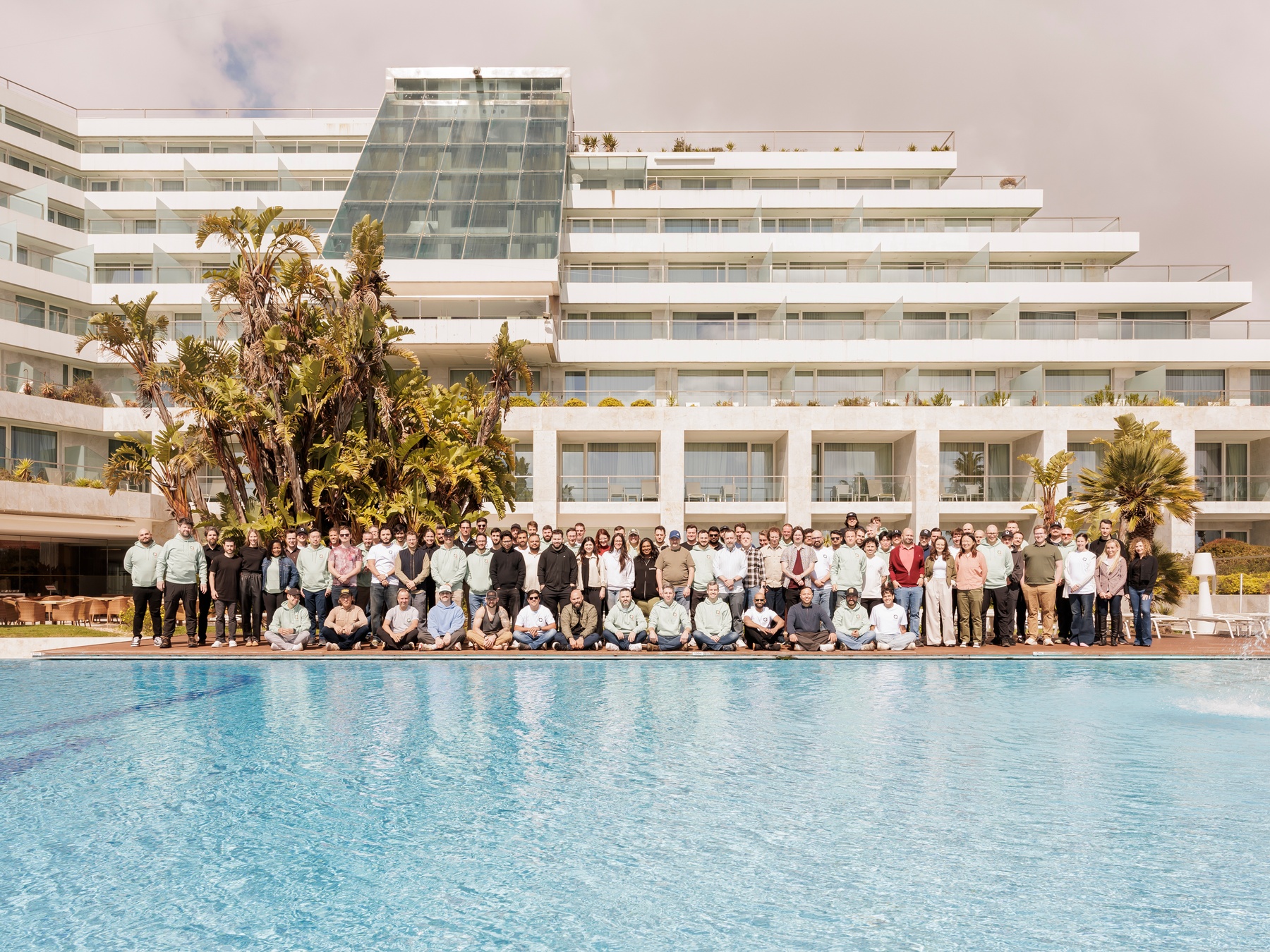
When a 130-person blockchain infrastructure company came to ATC for their annual offsite, the primary brief was retention. Their team was fully remote, spread across 20 countries, and the annual offsite was the only time the whole company gathered in person. For many employees, it was the only time they met colleagues from other regions at all.
The event budget was $1,800 per employee. The offsite came in at $1,566 per employee, under budget, despite a last-minute full destination change from Jamaica to Cascais, Portugal after Hurricane Melissa destroyed the original venue two months before the event. The event earned an 82 NPS. Ninety percent of the employee base attended in person.
For a company where culture and retention are the primary competitive advantage, quantifying the ROI of that offsite is straightforward: what would it cost to replace the employees who stayed partly because of the connection built at that event? Almost certainly more than $1,566 per person.
The one-page brief your CFO actually wants
When you go into the budget conversation, bring one page. Not a deck. One page with five elements:
The primary business objective (one sentence: "reduce voluntary turnover among senior ICs" or "increase 90-day pipeline post-SKO")
The total cost (fully loaded: travel, venue, food, planning fees, and a conservative estimate of productive hours lost)
The success metric and how you will measure it
The comparison: what does it cost if we do not do this (one retained hire math works here)
The precedent: 59% of companies have increased offsite budgets since 2019 (Emburse, 2025)
That is a business case. Five lines. Bring it in, leave it behind.
Frequently asked questions
How do I calculate the ROI of a company retreat?
What is the average cost of a company offsite per person?
How do you justify a company retreat to leadership or a board?
What metrics should I track to measure offsite success?