How to plan a corporate offsite for 100 or more people
Scale changes everything. What works for 30 people at a local hotel collapses under the weight of 100. Visa mismatches strand attendees. Master accounts spiral into finance nightmares. Jet-lagged teams sit through 8am sessions and retain nothing. The mistakes are predictable. Most of them happen for the same reason: companies treat a 100-person offsite like a bigger version of a 30-person offsite.
It is not. Here is how to plan one that actually works.
Step 1: Set one objective, not five
The first decision is also the one most often skipped. Before you look at a single destination or venue, write down what this offsite needs to accomplish. One or two things. Not seven.
Is this a strategy session where leadership needs to make real decisions? Is it a culture reset for a remote team that rarely sees each other in person? Is it a sales kickoff built around motivation and momentum? These are different events. They require different agendas, different venues, and different success metrics.
Trying to blend all of them produces a muddled experience that delivers none of them well. According to Gallup, employees who feel their organization's direction is clear are 3.8 times more likely to be engaged. The same principle applies to the offsite itself. Clarity of purpose determines everything downstream.
Step 2: Run a destination access audit before you fall in love with a location
At 100-plus people spread across multiple cities or countries, the destination choice is a logistics problem before it is an inspiration problem.
Score every candidate destination on four criteria:
- Maximum one layover for the majority of attendees
- Visa-free or visa-on-arrival entry for your team's passport mix
- A single property capable of housing the full group
- Flight frequency that survives one disruption without stranding half your people
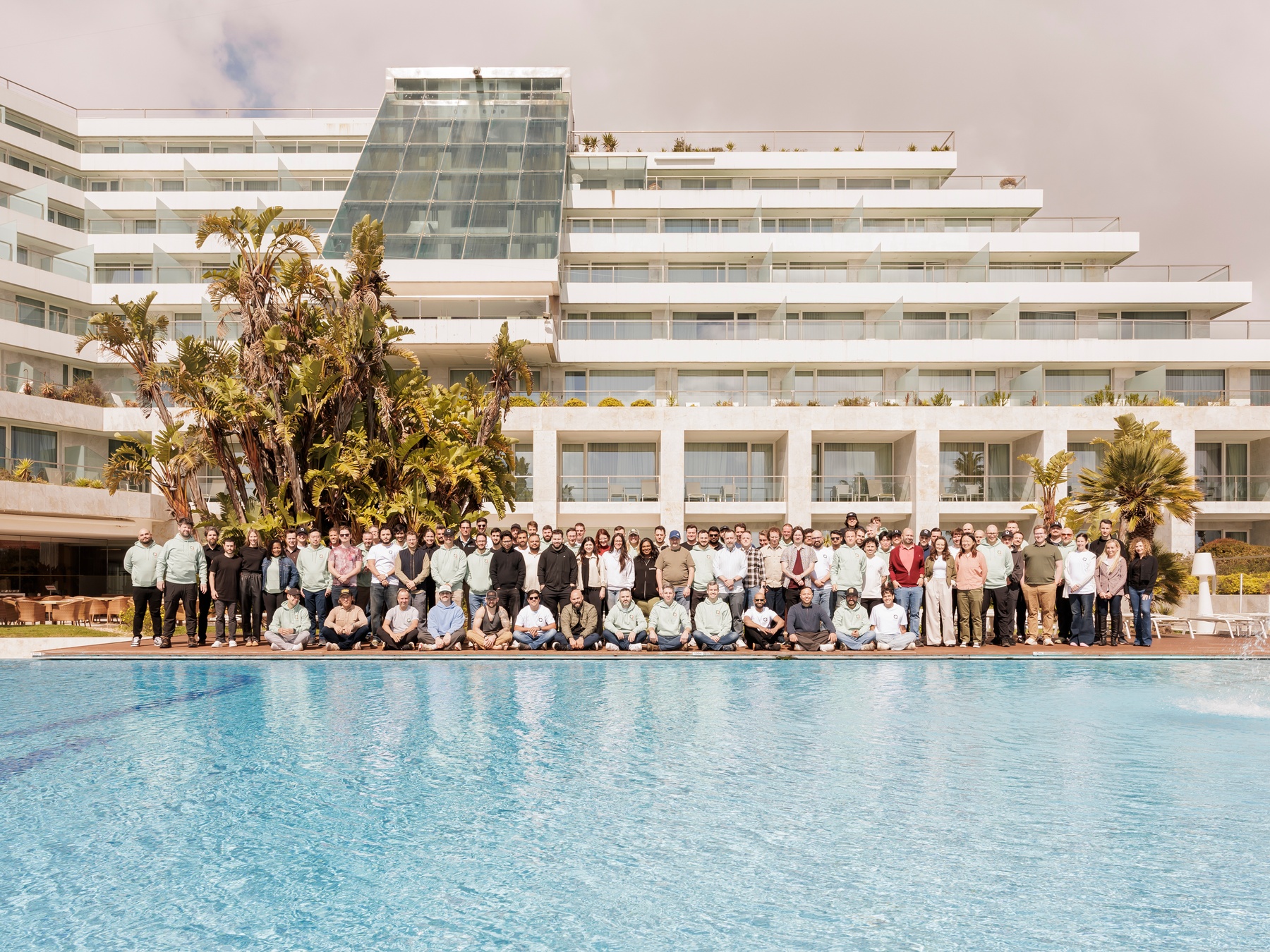
This is exactly how ATC approached the Lisbon offsite. The client, a Series B blockchain infrastructure company with 130 employees across 20 countries, originally chose a resort in Montego Bay, Jamaica precisely because it passed this test: accessible on at most one connection, visa-free for nearly every employee, walkable from the airport in under 20 minutes.
When Hurricane Melissa destroyed that venue two months before the event, ATC ran the same access audit again for Europe. Portugal cleared it. The Caribbean, with no available room blocks on short notice, did not. Destination strategy is not about what is beautiful. It is about what your team can actually reach.
Step 3: Negotiate the venue contract like a finance person
Four items in your venue contract will determine whether the event comes in on budget. Most planners underweight all four.
Master account scope. Define exactly what employee charges flow to the master account and what does not. If it is not written down, assume everything will end up on it.
Food and beverage minimums. These are often negotiable on off-peak dates and are almost never discussed at signing.
Attrition clauses. If attendance drops by 10 percent, you may owe the hotel for rooms you did not use. Know the threshold before you sign.
A/V costs. Hotel A/V is one of the most marked-up line items in corporate events. Get the number in writing before contract execution.
The Lisbon offsite came in at $1,566 per person, against a budget of $1,800, excluding flights. That result did not happen by accident. It happened because the billing structure was negotiated in detail before arrival, including a closed master account and individual card limits for employee incidentals. Each employee used their existing Ramp card for personal charges. The hotel agreed not to route anything to the master account without prior approval. Post-event checkout took hours, not days.
Step 4: Build the agenda around your team's actual energy
The single most common agenda mistake at international offsites is starting too early.
When a meaningful portion of your attendees have crossed four or more time zones, an 8am session is a waste of your most expensive time together. The Lisbon offsite learned this directly: the post-event debrief flagged early morning sessions as a drag on quality, and future programs will start later.
The fix is simple. Send pre-work before the event so the first session can skip orientation and go straight into substance. Build working sessions around genuine deliverables, not presentations. If the objective is strategic, structure cross-functional working groups around specific decisions that need to be made, not topics that need to be discussed.
And resist the instinct to pack every hour. A tight two-day agenda with real outputs beats a sprawling four-day agenda that exhausts people by day three. The Lisbon team used unstructured afternoon time, with a local guide and a curated list of things to do within walking distance of the hotel in Cascais, as a feature rather than a gap. Employees rated the free time and the two privatized Michelin-star dinners as the highlights of the event. The 9.6 out of 10 satisfaction score followed.
Step 5: Build a backup plan before you need one
This is not optional at scale.
High-investment events carry real risk: weather, venue closures, civil disruption, infrastructure failures. At 30 people, a pivot is painful. At 130 people flying from 20 countries, a pivot with no pre-built backup becomes a company-wide crisis.
The Lisbon offsite was rebuilt entirely from scratch in under three months after the Jamaica venue closed. ATC had pre-mapped alternative destinations and understood the rebooking windows with each vendor. That preparation is what allowed 90 percent of the employee base to still attend in person despite a full destination change, active flight disruptions through the Middle East, and a compressed planning timeline.
Ask your venue: what is the force majeure provision? Ask yourself: if this venue closes in six weeks, what is our next call?
Step 6: Assign one accountable owner, and make sure it is not your Head of People
The finance and people teams at the Lisbon client had been planning the annual offsite internally for three years. By the fourth year, with 130 employees, the logistics had consumed the working lives of two senior employees. That is not a planning problem. It is a scope problem.
At 100-plus attendees, the coordination load includes multi-country flight tracking, individual room assignments, master account management, local vendor contracts, dietary and accessibility requirements, real-time onsite troubleshooting, and post-event reconciliation. None of that is a senior leader's highest-value work.
A dedicated external planning partner handles all of it and gives the internal team a single point of contact. When the Jamaica hurricane hit, the client did not have to manage the crisis. ATC rebuilt the event. The internal team stayed focused on the work only they could do.
Frequently asked questions
How far in advance should we start planning a corporate offsite for 100 or more people?
What is a realistic per-person budget for a 100-person corporate offsite?
How do you manage employee spending at a non-all-inclusive property?
Should the offsite focus on strategy or team building?