Your reorganization is done. The org chart is published, the announcement went as well as it could, and now you're supposed to get everyone working again as though the past six weeks of uncertainty hadn't happened.
Here's what works to resolve the chaos: a three day leadership retreat after the reorganization, for 10 to 25 people, starting 30 to 60 days after the new chart takes effect. A nine question survey goes out three weeks ahead. The agenda gets written before anything is booked. Everyone leaves with four documents to create alignment.
Below is your guide on what to do.
The 30 day rule
Before 30 days nobody will be present and focused at your retreat. Your people are still working out how their responsibilities and goals have changed, so you'll get a polite conversation where everyone agrees and nothing changes.
After 60 days the problem has hardened. Someone's been routing approvals through their old manager because it's faster. Two teams have quietly split an enterprise account nobody assigned properly. Now your retreat has to undo three months of bad habits before it can improve anything.
Already past 60 days? Run a retreat anyway. Add a session on day one called "how we're working now" and write down what's really happening before you try to replace it. You'll get further legitimizing the good workarounds than pretending they don't exist.
What the reorganization actually broke
Four things typically break. Each needs its own session, because each gets fixed by a different conversation.
- Nobody knows who the decision-makers are. Two of your directors both believe they own pricing, but neither will say so with the chief executive in the room, so a decision that should take an afternoon sits untouched for three weeks. Nobody escalates the issue, because escalating sounds like telling the chief executive the new org chart is broken.
- People who competed for the same promotion six weeks ago now share a metric they're both measured on. They're polite in meetings and route around each other everywhere else. The trust battery between them is empty.
- Your announcement explained the changes to the organization, but not the new job descriptions for everyone. So people quietly default to their old job, which is the only one anybody ever wrote down for them.
- Often, people keep taking direction (even if informally) from their previous manager.
Underneath all four is the real cause: people just don't follow the new chart. They follow whatever gets their work done fastest, so within about eight weeks of any restructure your company is running on the shadow org chart: the approvals, handoffs, and back channels your people invented because the official version was too slow or too unclear.
So your retreat is really an excavation to drag the shadow chart into the open and decide together which parts to keep and which to kill. None of that is doable by a keynote and a nice dinner, which is one big reason corporate offsites fail.
The survey you send three weeks out
Send this three weeks ahead, to everyone attending plus everyone who reports to them. Close it seven days before, so you've got time to read it and change the agenda. Anonymous, five minutes, nine questions.
Use these as written:
- Since the new structure was announced, name one decision that's taken longer than it should have. What was it?
- Who do you believe is supposed to make that decision?
- On a scale of 1 to 10, how clear are you on what you personally have to deliver this quarter?
- What's one thing you're still doing that somebody else now owns?
- Where are two teams doing the same work?
- When you need something approved fast, who do you go to? Is that the person on the chart?
- What would you change about the structure if it were your call?
- What's going better since the change?
- What do you think leadership doesn't know?
Question six is the one that unearths your shadow chart, because it asks people to compare what they do against what the chart says they should do. Almost nobody has been asked that directly before.
This has to come from the chief executive personally. Not an assistant, not a survey tool with a generic sender. Promise in the same message to share the results at the retreat, then do it, because people answer honestly when they will be confronted by their answers in the future.
Here's the email:
Subject: 5 minutes, before the leadership offsite
I'm sending this survey in advance of our retreat. I want your unvarnished responses, which will dictate the agenda. It’s anonymous, just nine questions and should take about 5-10 minutes of your time. It closes on [date].
We'll review the results together on day one. If something's broken about how we're working since the reorganization, I'd rather hear it now.
[link]
Expect the answers to contradict what your leadership team believes. The usual pattern: leadership thinks the problem is strategy, but the survey says nobody knows who signs off on anything. Those two diagnoses need completely different agendas, so digest the results before you finish your schedule.
Writing a session goal that can end
Most of the work is in how you word things. Here's one session goal written three ways.
- Bad: "Discuss roles and responsibilities."
- Good: "Clarify who owns pricing, discounting, and contract exceptions."
- Great: "Name the directly responsible person for each of the 11 projects that went off-track since April, and write the names on the wall."
The first has no output at all. The second has a topic without a finish line, so it dissolves into a discussion everyone feels good about but nobody acts on. The third gives you a number, a deliverable, and a way to know you're finished.
Write every session goal like the third one.
The agenda, hour by hour
Three days, 10 to 25 people, nine o'clock start.
Day one is diagnosis.
- 9:00 to 9:30. The chief executive reads the survey results aloud. The actual answers, including the ones that sting. This half hour determines whether the next three days yield results.
- 9:30 to 11:00. Every stalled decision / workstream goes on the wall, one per sheet.
- 11:15 to 12:30. Assign one name to each, written down, in front of everyone.
- 1:30 to 3:00. Duplicate work. Same method: name it, then give it just one owner.
- 3:15 to 5:00. The shadow chart. Ask who people go to for fast approvals, then write down what they say. This is the session that likely needs an outside facilitator.
- Evening: unstructured dinner, no agenda, no speeches.
Day two is rebuilding.
- 9:00 to 10:30. Each leader presents one page: what I own, what I deliver by quarter end, what I need from whom, what I've stopped doing. Cap each at 10 minutes.
- 10:45 to 12:30. Pick the three handoffs between teams that matter most. Define each one: who sends what, to whom, by when, in what form.
- 1:30 to 3:30. Agree the single company metric this restructure was supposed to move. Write down that metric’s value before the reorg and now as a baseline.
- 3:45 to 5:00. Every person names one thing they'll have finished in 90 days, with a target date.
- Evening: something offsite that isn't a forced team building exercise.
Day three closes it.
- 9:00 to 10:30. Read the documents back. Fix what's wrong while everyone's still in the room.
- 10:45 to 11:30. Week one: who tells their teams what, and when.
- 11:30 to 12:00. Book the 90 day session before anyone leaves.
The four documents you leave with
A reorg focused retreat that produces a feeling instead of documents didn't work. Share these within 48 hours:
- The decision list. Every stalled decision / project, one name against each, on one page
- The mandate pages. One per leader, in their own words: what I own, what I deliver by quarter end, what I need from whom, what I've stopped doing.
- The handoff definitions. Three handoffs, each written as who sends what, to whom, by when, in what form.
- The 90 day list. Every commitment with a person and a date.
Four documents, all short enough to review on a phone. The same "design backward from the goal" approach runs through the Affinity Travel Co. offsite planning framework.
Do the math before you argue about cost
Somebody will ask whether three days of your leadership team's time is worth it. Answer with numbers. Two figures matter: what the retreat costs in opportunity cost of payroll versus what you're losing while the structure stays unclear.
Start with payroll. A leader on $200,000 a year salary costs about $96 an hour once you divide by the 2,080 working hours in a year. Multiply that by 20 people, then by the 24 working hours a three day retreat eats: roughly $46,000 of salaried time before you've booked a single flight.
Now put it against what you're fixing. Gallup puts the gap between the most and least engaged business units at 23% in profitability and 43% in turnover. Manager engagement fell from 27% to 22% between 2024 and 2025, the sharpest single year drop on record, with overall engagement at 20%. Your managers just absorbed a restructure. They're the population with the least capacity left to fix it themselves and they’re likely worn out.
Reorganizations don't reliably self-correct. Harvard Business Review reports that two-thirds of them deliver at least some performance improvement, which means a third deliver none at all.
Our post on building the business case works through how to put this argument in front of finance.
The 90 day check
Plan to check on progress twice. Book both dates now, before people leave, because we’ve never once seen a client schedule it afterward with full attendance.
At 30 to 45 days, send two questions to everyone who took the first survey: how clear are you on what you have to deliver, 1 to 5, and is the decision list correct? Compare the key metric you noted against your baseline.
At 90 days, look again at the one company metric you agreed on. Then read the commitment list aloud in a leadership meeting, name by name, and get statuses.
A commitment list nobody reads again teaches everyone that the next retreat is optional. Moreover, it tells people that achieving promised results is not the most important thing.
Why an outsider runs the hard sessions
Why can't your chief of staff run it? Because everybody inside your company who could facilitate is a party to the restructure. The chief of staff running the session about who decides what is also somebody whose own job changed six weeks ago. Everyone is nervous and frazzled, so you get a courteous version of the truth, which yields no improvements.
Hire somebody external for day one afternoon and day two morning.
The same logic applies to the venue. Write the agenda, list the rooms it needs, then go looking. Your day one sessions need one room where 25 people can see each other's faces, which rules out a long boardroom table and most hotel meeting space. Day two needs three smaller rooms within a minute's walk from each other. You need wall space for the decision list, which sounds trivial right up until you're standing in a beautiful room with windows on three sides and nowhere to stick paper.
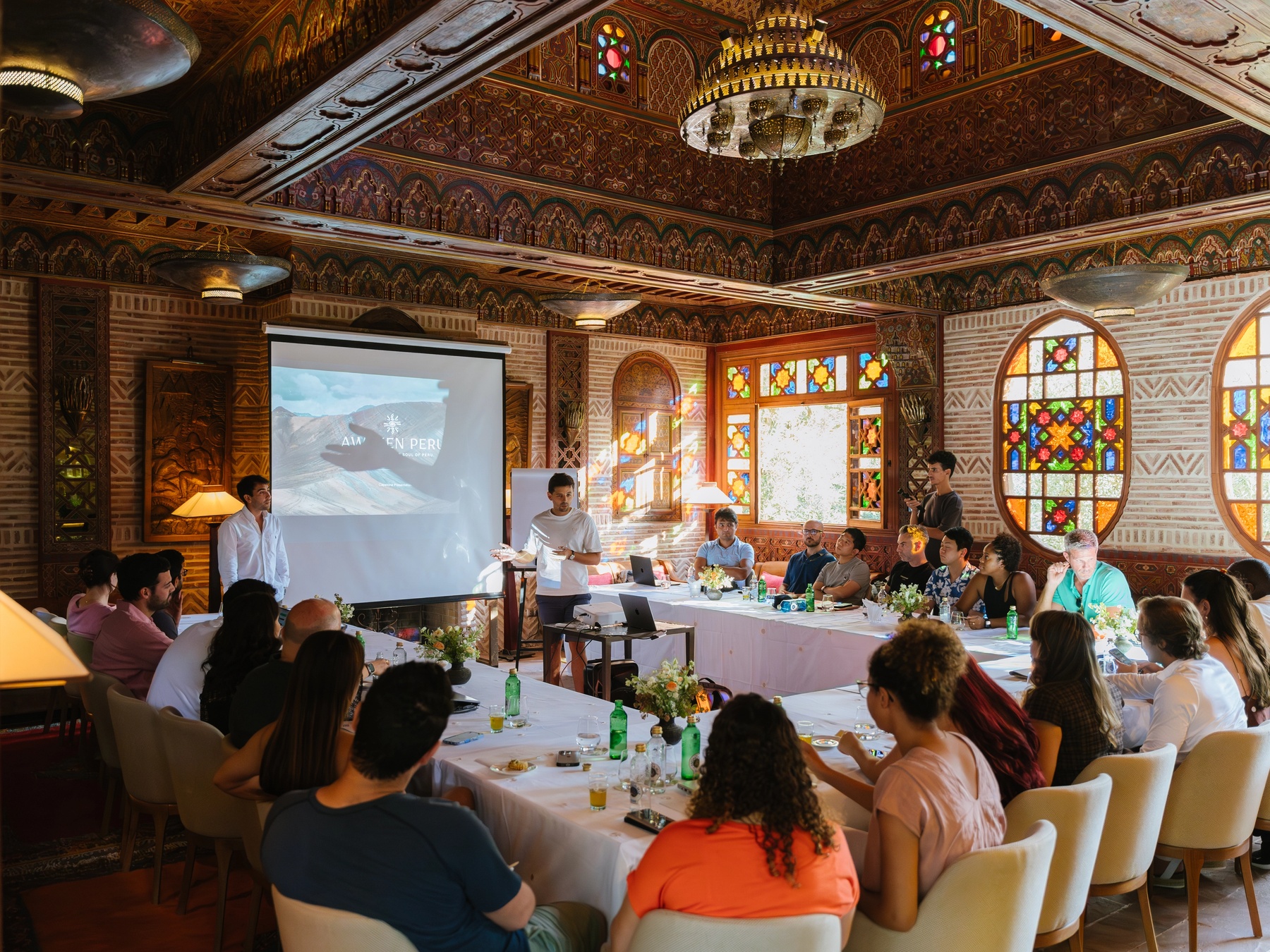
Our Morocco leadership retreat in the Atlas Mountains was built that way, with the working sessions led by the individual leaders instead of the executive team. That group left with 34 best practices ready to use. The company retreat for a growing tech startup scored an event Net Promoter Score of 87, with over 80% saying they felt clearer on strategy afterward.
None of the planning is hard. It's tedious, it's unglamorous, it lands on somebody who already has a full job. Book 15 executives out of nine cities and you have 15 separate itineraries, so when one changes, the transfers and your day one start time move with it.
Then it's seven in the morning on day one. A flight's been canceled, your facilitator missed a connection, the private dining room is double booked. Somebody has to fix all three while your chief executive is running the opening session. If that somebody is the chief of staff, the person who was supposed to capture who owns pricing is at the concierge desk instead.
Affinity Travel Co. is a single partner that plans and executes corporate offsites, executive retreats, sales kickoffs, conferences, and incentive travel for groups of 10 to 500, booking and managing every vendor from venue and air to private dining and ground transport, with staff on site for the program. We've run 30+ programs across 28 countries for 900+ guests.
On what modulates the cost, our corporate offsite budget guide and full cost breakdown go through how group size, private rooms, airport distance, and the facilitator's fee interact. Or see how we think about executive retreats and request a proposal.
Frequently asked questions
How soon after a reorganization should we run a leadership retreat?
How many people should attend a post-reorganization leadership retreat?
Should the CEO facilitate the retreat?
What should we ask in the pre-retreat survey?
How do we know the retreat worked?
What does a leadership retreat for 20 people cost?